
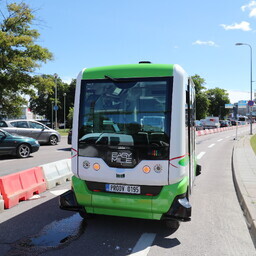
Currently, self-driving buses in Estonia are used only for testing or on short routes. A doctoral thesis from Tallinn University of Technology showed that people become more confident about buses when they have personal experience with them.
Krister Kalda, head of the entrepreneurship department at Tallinn University of Technology, says that machines make fewer mistakes than humans. For example, many traffic accidents occur because the driver is using a phone. In a self-driving bus, a person can work on a laptop instead.
In Estonia, self-driving buses are still only used for testing. Krister Kalda explored in his doctoral thesis how they could be introduced more widely. He studied how people interact with buses and how buses operate in different situations.
In one test in Rae, people used a self-driving bus. Before the test, 43% of people said they would use a self-driving bus. After the test, this number rose to 86%.
The study also examined how different people accept self-driving vehicles. Estonians prefer that there be no driver in the car. People of Russian background and older people, however, would like a conductor to create a sense of safety.
Another study focused on a test conducted in Rae. People could order the bus via a mobile app or website. The test showed that people want to use self-driving buses for local services. For example, children were very excited to ride a kindergarten bus.
In Rae, 1000 people were surveyed before and after the test. People became twice as favorable towards self-driving buses.
In a test in Kadriorg Park, the buses drove around and were situationally aware. For example, if there were leaves on the ground in the park, the bus braked. There were also problems with cyclists sabotaging the bus.
Kalda also studied how to handle situations where a person is carrying heavy luggage. The result showed that people want to use self-driving buses for local services.
Currently, the safety level of self-driving buses is such that they are better suited for short trips. For example, they could be used at airports or zoos.
In Estonia, three companies have tested self-driving buses. One of them has ceased operations. The other two are a company that grew out of Tallinn University of Technology's lab and the lab's researchers.
Kalda recommends that more testing and better sensors should be used to introduce self-driving buses. Safety also needs to be improved, and tests should be conducted during winter.
Kalda claims that self-driving buses reduce air pollution and help improve mobility for blind people. They also have economic benefits, as they can operate in areas with low traffic volumes.