
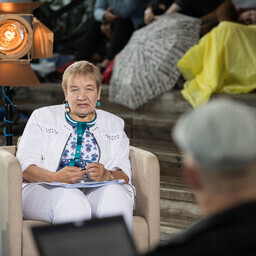
Helle Metslang received the national science award in the field of humanities. She studied the use and diversity of the Estonian language. Metslang led a major project that resulted in a new Estonian grammar. This grammar shows how the Estonian language is used today.
Metslang heard about the award during a meeting. She was surprised and happy. She said that her research has been a great collaboration with many people. Her work has focused on interesting topics and discussions with colleagues. She has written many articles and books.
Metslang led a major grammar project. She studied together with Külli Habicht how the Estonian written language developed in the 19th century. She also studied how the German language influenced Estonian authors.
Metslang has also researched regilaul (traditional Estonian folk songs) with the people from the Estonian Literary Museum. She also participated in a project that studied subjectivity and intersubjectivity in the Estonian language.
Metslang said that there are many good ideas in research, but sometimes it is difficult to implement them. There is sometimes little money, and one has to fight for the project to continue. For example, the project on subjectivity and intersubjectivity has now ended, and people are working on new topics. Metslang said that research is a game of luck when you can continue what you started.
Metslang said that it would be exciting to study how the Estonian written language developed in the 19th century. She would like to study how Estonian emerged from German and how the language changed in people's attitudes. Külli Habicht's team has asked for funding for this project, but she has not received it.
Metslang said that scientists should have work that allows them to continue with their topics. She recommended that young scientists go abroad for postdoctoral studies. She would like research teams to be able to do what they are good at and what they have started.