
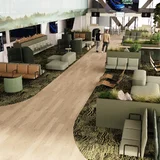
Tallinn Airport plans to expand its passenger terminal. For this purpose, approximately 66.6 million euros will be invested. Major construction works will begin next year.
The goal of the expansion is to make the terminal larger and more comfortable. Currently, the airport serves about 3.8 million passengers annually, although the terminal was designed for 2.8 million passengers. In the future, the terminal will be able to serve up to five million passengers per year.
Riivo Tuvike, the Airport Director, says that the airport needs more space. The expansion will help reduce waiting times and improve services. The comfort characteristic of the airport will also be preserved.
Construction works will last 31 months. Air traffic and terminal operations will continue throughout the construction period. However, passengers should be prepared for temporary changes.
Kaido Somelar, the director of Tallinn Construction Trust, explains that new areas will be added and existing ones will be modernized. Approximately 16,500 square meters of new space will be added to the passenger terminal. Additionally, 18,000 square meters of existing space will be renovated.
As part of the expansion, a new part of the terminal will be built in place of a parking lot. New shops, dining areas, and baggage handling areas will be added there. Two new boarding gates will also be added, and the aircraft parking and service area will be expanded.
The border control and gate areas will be expanded to improve the handling of non-Schengen flights. Retail and dining areas will also be modernized.
Preparatory works will begin in the autumn. Major construction inside the passenger terminal will start in early 2027. Air traffic will continue uninterrupted.
The condition of the old airport building, known as Sepise 2, is currently unclear. The airport wishes to demolish it, but heritage authorities consider the building valuable. Margot Holts, the Communications Director of the airport, says that no final decision has been made yet.
Holts explains that the issue of the old building does not affect the current expansion works. The building is located in an area that could be used for future development of the terminal or aircraft areas. The airport aims to collaborate with heritage authorities and the city to find a solution that considers both the building's value and the airport's needs.