
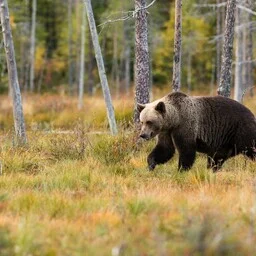
There are many bears living in Estonia. Many say there is too little space for them in the forest. Is this true? Scientists from the University of Tartu are researching this.
Bears are very important for nature. They eat various foods and help keep nature clean. Bears also consume dead animals, which helps nature recover faster.
There are about 20,500 bears in Europe. Bears live where there are few humans. Their habitats vary in size. For example, in the Alps, a bear's home range can be 57–74 square kilometers, while in Serbia, it can even exceed 4,000 square kilometers.
Bears do not want to live near humans. Studies show that bears move more at night when humans are less active. Young bears gradually learn to avoid humans.
There is little data about bears in Estonia. One study showed that a female bear lived in the Väike-Maarja region. Her home range was nearly 62 square kilometers.
Bears may come close to humans because they are searching for food or fleeing from other bears. Young bears and female bears are particularly prone to this.
To better understand how and where bears move, scientists use GPS collars. These collars track the bears' movements. Scientists from the University of Tartu are raising funds to purchase more collars and study bear life even more precisely.