
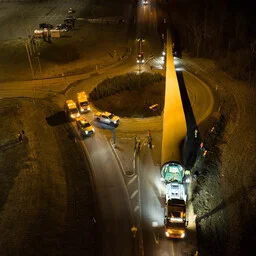
According to the Transport Administration, two routes will be used for transporting wind turbine components.
The first route runs along the Tallinn ring road to Jälgimäe, then through Saku borough to Uusküla. From there, it passes by Rapla and continues to Kergu. The journey then continues along the Aluste–Kergu highway to Aluste, then through Tori, Paikuse, Abja-Paluoja, and Penuja village to Latvia.
The second route goes along the Tallinn ring road to the Tallinn–Tartu highway, then through Imavere towards Viljandi. From there, it passes by Viljandi to Kõpu, where the journey continues along the Valga–Uulu highway to Mereküla and then further along Via Baltica to the Latvian border.
The Transport Administration has issued special permits for oversized transport. These permits allow the use of roads at night between 21:00 and 6:00. Up to four convoys will move each night, with each convoy consisting of up to four special transports.
The length of a transport vehicle is up to 90 meters, and the height is up to 5.6 meters. In total, 16 wind turbine components will be transported to Latvia. The transport will take place in the evenings and at night to minimize traffic disruption. The transport operations will last for two months.
Preparation work has been carried out along the routes in April. Temporary road extensions and access ramps at roundabouts are being constructed. Traffic signs are being removed and replaced with temporary ones.
Although no roads will be closed during the transport, drivers should expect obstacles and delays. The client for the wind turbine transport is Baltic Road & Wind Solutions MB, and Ramudden OÜ is responsible for traffic management.