
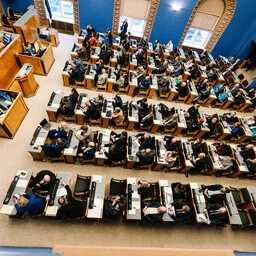
Riigikogu võttis esmaspäeval vastu uue seaduse.
See seadus muudab lihtsamaks töötajate toomise Eestisse välismaalt
. 45 riigikogu liiget hääletasid poolt ja 31 vastu. Koalitsioonisaadikud hääletasid peamiselt poolt. Mõned ei hääletanud üldse.
See seadus muudab lihtsamaks töötajate toomise Eestisse välismaalt
Tõlge fraasile: See seadus muudab lihtsamaks töötajate toomise Eestisse välismaalt
EN
This law makes it easier to bring workers to Estonia from abroad
Uus seadus aitab lahendada tööjõupuudust.
Eestis on igal aastal vaja ligi 1400 spetsialisti ja 700 oskustöötajat
. Praegu ei piisa Eesti haridussüsteemist nende vajaduste katmiseks.
Eestis on igal aastal vaja ligi 1400 spetsialisti ja 700 oskustöötajat
Tõlge fraasile: Eestis on igal aastal vaja ligi 1400 spetsialisti ja 700 oskustöötajat
EN
Estonia needs about 1400 specialists and 700 skilled workers every year
Seadus muudab töötamise tingimusi.
Tööjõupuudusega aladel saavad töötajad lihtsamini elamisloa
.
Palganõue on 80% Eesti keskmisest palgast
. See aitab vältida odava tööjõu sissetoomist.
Tööjõupuudusega aladel saavad töötajad lihtsamini elamisloa
Tõlge fraasile: Tööjõupuudusega aladel saavad töötajad lihtsamini elamisloa
EN
In areas with labor shortages, workers can more easily obtain residence permits
Palganõue on 80% Eesti keskmisest palgast
Tõlge fraasile: Palganõue on 80% Eesti keskmisest palgast
EN
The salary requirement is 80% of the Estonian average salary
Valitsus teeb tööjõupuudusega alade nimekirja
. Sellel on selged reeglid. Nimekiri kehtib kuni viis aastat. Praegu on need tööstus ja transport.
Valitsus teeb tööjõupuudusega alade nimekirja
Tõlge fraasile: Valitsus teeb tööjõupuudusega alade nimekirja
EN
The government is making a list of areas with labor shortages
Elamislubade arv sõltub majandusest
. Hea majandusega aastal saab anda kuni 2600 luba. Halvemal ajal kuni 1300 luba.
Elamislubade arv sõltub majandusest
Tõlge fraasile: Elamislubade arv sõltub majandusest
EN
The number of residence permits depends on the economy
Seadus toob riigile rohkem makse. Aastas võib tulla 14-27 miljonit eurot. Kui töötajad jäävad pikemaks, võib summa olla veel suurem.
Riigikogu võttis vastu ka teise seaduse. See seadus järgib Euroopa Liidu reegleid. See aitab välismaalastel lihtsamini töötada Eestis. 41 liiget hääletasid poolt ja 25 vastu.
Uus seadus lubab töötajatel vahetada tööandjat
. Selleks ei pea uut elamisluba taotlema. Uus tööandja peab seda lihtsalt teatama.
Uus seadus lubab töötajatel vahetada tööandjat
Tõlge fraasile: Uus seadus lubab töötajatel vahetada tööandjat
EN
The new law allows workers to change employers
Töötajad võivad nüüd olla tööta kauem
. Kui elamisluba on alla 2 aasta, siis kuni 3 kuud. Pikema loa puhul kuni 6 kuud. Erandjuhul kuni 9 kuud.
Töötajad võivad nüüd olla tööta kauem
Tõlge fraasile: Töötajad võivad nüüd olla tööta kauem
EN
Workers can now be unemployed for longer
Pikaajalised töötajad saavad nüüd sotsiaaltoetusi
. Näiteks vanemahüvitist või pensioni. Kuid peretoetusi nad ei saa.
Pikaajalised töötajad saavad nüüd sotsiaaltoetusi
Tõlge fraasile: Pikaajalised töötajad saavad nüüd sotsiaaltoetusi
EN
Long-term workers can now receive social benefits
Viimastel aastatel on rikkumisi rohkem
. 2021. aastal oli 380 rikkumist. 2024. aastal juba 524. Trahvid olid liiga väikesed. Nüüd tõstetakse trahve.
Maksimaalne trahv on nüüd 100 000 eurot
.
See peaks aitama rikkumisi vähendada
.
Viimastel aastatel on rikkumisi rohkem
Tõlge fraasile: Viimastel aastatel on rikkumisi rohkem
EN
In recent years, there have been more violations
Maksimaalne trahv on nüüd 100 000 eurot
Tõlge fraasile: Maksimaalne trahv on nüüd 100 000 eurot
EN
The maximum fine is now 100,000 euros
See peaks aitama rikkumisi vähendada
Tõlge fraasile: See peaks aitama rikkumisi vähendada
EN
This should help reduce violations
The Riigikogu passed a new law on Monday. This law makes it easier to bring workers to Estonia from abroad. 45 members of the Riigikogu voted in favor and 31 against. Coalition members mainly voted in favor. Some did not vote at all.
The new law will help solve labor shortages. Estonia needs nearly 1,400 specialists and 700 skilled workers every year. Currently, the Estonian education system is insufficient to meet these needs.
The law changes working conditions. In areas with labor shortages, workers can more easily obtain residence permits. The salary requirement is 80% of the average Estonian salary. This helps avoid bringing in cheap labor.
The government will create a list of areas with labor shortages. It has clear rules. The list is valid for up to five years. Currently, these are industry and transport.
The number of residence permits depends on the economy. In a good economic year, up to 2,600 permits can be issued. In worse times, up to 1,300 permits.
The law will bring more taxes to the country. Annually, it could generate 14-27 million euros. If workers stay longer, the amount could be even higher.
The Riigikogu also passed a second law. This law follows European Union rules. It helps foreigners work more easily in Estonia. 41 members voted in favor and 25 against.
The new law allows workers to change employers. They do not need to apply for a new residence permit. The new employer simply needs to notify the change.
Workers can now be unemployed for longer. If the residence permit is less than 2 years, up to 3 months. For longer permits, up to 6 months. In exceptional cases, up to 9 months.
Long-term workers can now receive social benefits. For example, parental benefits or pensions. However, they do not receive family benefits.
In recent years, violations have increased. In 2021, there were 380 violations. In 2024, there were already 524. Fines were too low. Now, fines are being increased. The maximum fine is now 100,000 euros. This should help reduce violations.