
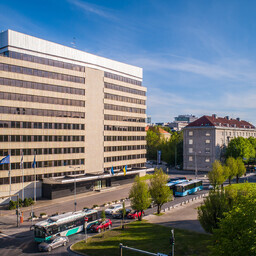
Välisministeerium
uurib, kuidas saaks renoveerida oma
peahoone
t Tallinnas. Hoone on
muinsuskaitse all
ja asub
Islandi väljak
ul. Praegu on tegemist vaid ettevalmistustega, sest renoveerimine maksaks umbes 40 miljonit eurot. Rahastust veel pole otsustatud.
Välisministeerium
Tõlge fraasile: Välisministeerium
EN
Ministry of Foreign Affairs
peahoone
Tõlge fraasile: peahoone
EN
main building
muinsuskaitse all
Tõlge fraasile: muinsuskaitse all
EN
under heritage protection
Islandi väljak
Tõlge fraasile: Islandi väljak
EN
Island Square
Hoone
tehnosüsteemid
on vanad, need pärinevad aastast 1968. Ametnike büroodes pole näiteks
ventilatsioon
i ega
jahutus
t. Turvanõuete tõttu ei saa ka aknaid lahti teha. Keldriga on ka probleeme, seal lekkib vee- ja
kanalisatsioonitorud
est.
tehnosüsteemid
Tõlge fraasile: tehnosüsteemid
EN
technical systems
ventilatsioon
Tõlge fraasile: ventilatsioon
EN
ventilation
jahutus
Tõlge fraasile: jahutus
EN
cooling
kanalisatsioonitorud
Tõlge fraasile: kanalisatsioonitorud
EN
sewage pipes
Hoones on tehtud väiksemaid remonte, kuid suurt renoveerimist pole tehtud.
Välisministeerium
pöördus Tallinna linnaplaneerimise ametisse, et teada saada, mis hoones on kultuuriväärtuslik ja millised nõuded renoveerimisel tuleb arvestada.
Välisministeerium
Tõlge fraasile: Välisministeerium
EN
Ministry of Foreign Affairs
Põhiline raskus on rahastuses. Riik pole veel raha renoveerimiseks eraldanud. Eelarves on vaid mõnikümmend tuhat eurot ettevalmistustöödeks. Praegu koostatakse projekteerimise plaane ja hinnatakse
ruumivajadus
i.
ruumivajadus
Tõlge fraasile: ruumivajadus
EN
space requirement
Üks hoone osa on tuntud
Kilukarbisaal
. See on suur saal, kus lakke on kinnitatud 60 000 kilukarpi. Saal kasutuses ei ole, sest see on lagunemas. Tulevikus tuleb otsustada, mis saaliga teha.
Kilukarbisaal
Tõlge fraasile: Kilukarbisaal
EN
Herring Can Hall
Tallinna muinsuskaitse komisjon kohustas hoonet uurima. Uuringus selgitatakse, millised hoone osad on kultuuriväärtuslikud. Hoone valmis 1968. aastal ja selle arhitektid olid Mart Port, Uno Tölpus, Raine Karp ja Olga Kontšajeva.
Hoone on
11-korruseline
ja sellel on
sümmeetriline fassaad
. Esimesel korrusel on suur vestibüül, kus seinad on kaetud
roosa marmor
iga. Ülejäänud korrustel on bürood ja saalid. Hoone keskel on
sisehoov
.
11-korruseline
Tõlge fraasile: 11-korruseline
EN
11-storey
sümmeetriline fassaad
Tõlge fraasile: sümmeetriline fassaad
EN
symmetrical facade
roosa marmor
Tõlge fraasile: roosa marmor
EN
pink marble
sisehoov
Tõlge fraasile: sisehoov
EN
inner courtyard
The Ministry of Foreign Affairs is exploring how to renovate its headquarters in Tallinn. The building is under heritage protection and is located on Islandi Square. Currently, only preparations are underway, as the renovation would cost around 40 million euros. Funding has not yet been decided.
The building's technical systems are old, dating back to 1968. For example, officials' offices lack ventilation and cooling. Due to security requirements, windows cannot be opened either. There are also issues with the basement, where water and sewage pipes are leaking.
Minor renovations have been carried out in the building, but no major renovation has been done. The Ministry of Foreign Affairs approached the Tallinn City Planning Department to determine what is culturally valuable in the building and what requirements must be considered during the renovation.
The main challenge is funding. The state has not yet allocated money for the renovation. The budget includes only a few tens of thousands of euros for preparatory work. Currently, design plans are being prepared, and space requirements are being assessed.
One part of the building is known as the Kilukarbisaal (Herring Can Hall). It is a large hall where 60,000 herring cans are attached to the ceiling. The hall is not in use because it is falling apart. In the future, a decision must be made about what to do with the hall.
The Tallinn Heritage Conservation Commission has ordered the building to be examined. The study will clarify which parts of the building are culturally valuable. The building was completed in 1968, and its architects were Mart Port, Uno Tölpus, Raine Karp, and Olga Kontšajeva.
The building is 11 stories high and has a symmetrical façade. On the ground floor, there is a large vestibule where the walls are covered with pink marble. The other floors contain offices and halls. In the center of the building is an inner courtyard.