
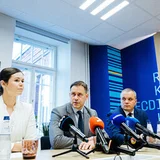
RKIK does not know how the contract with Datasel was made. RKIK’s CEO Elmar Vaher said that he and his team were not working at that time. Therefore, they do not know how the negotiations initially took place.
Information from the media suggests that Datasel used images from other websites and even a computer game cover image for its proposal. RKIK does not know why the decision was made to conclude the contract with Datasel. Nor are there documents showing how contact was established with Datasel.
RKIK has also not conducted a background check on Datasel. Usually, it is checked whether the company has the technology it offers and whether it can deliver it. The company’s finances are also reviewed, including the existence of investors and bank guarantees.
Elmar Vaher said that the European Commission will send an investigation team to Estonia in September. It will examine how RKIK carried out its work.
RKIK has terminated seven contracts related to Datasel. Five of them are in court or arbitration. Two contracts have been terminated, but negotiations are ongoing regarding them. RKIK does not comment on the two latest contracts because negotiations are confidential.
Datasel has submitted a counterclaim to RKIK, but its exact content is not disclosed. RKIK has not seen the claim documents. RKIK does not rule out that this may be a tactical move. The financial amount is not disclosed by RKIK.
The 70 million euro funding related to Datasel came from the European Peace Facility. It did not come from Estonian taxpayers. The background of this money is frozen Russian assets.
RKIK currently has approximately 200 procurement projects in progress, handled by about 80 people. Contract decisions are made by RKIK and signed by the CEO of RKIK. RKIK is responsible for its actions.
RKIK’s deputy CEO Asko Kivinuk said that RKIK is involved in procurement already at the planning and pricing stage. Procurement plans are made based on the development plan of the Ministry of Defense.
RKIK’s advisory lawyer Maria Pihlak emphasized that court and arbitration proceedings are closed. The parties cannot comment on the details of the proceedings in public.
The contracts contain confidentiality clauses. Therefore, RKIK must be careful about what information is disclosed.
Elmar Vaher said that RKIK did not hide data from the state audit. A technical error prevented the documents from being sent. The necessary documents were sent to the state audit on May 21 and again on June 5, but they did not arrive.
Vaher took responsibility for the documents not being checked. The lesson from the Datasel case is that the justification and documentation of procurement decisions must be properly recorded.
In the proceedings taking place in Harju County Court, RKIK or the Estonian state is represented by lawyers Raul Kartsep, Maria Pihlak, and Kaupo Lepasepp. Datasel is represented by lawyers Maksim Kozlov, Veiko Viisileht, and Liina Rekand.