
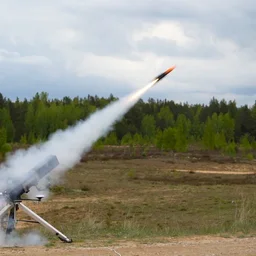
Polish defense industry company PGZ and Estonian technology company Frankenburg Technologies have signed an agreement. The contract will initiate the production of rockets against drones, called Mark 1.
Currently, the issue in air defense is cost. Expensive rockets are usually used to shoot down attack drones. This quickly leads to the depletion of reserves. Frankenburg Technologies’ Mark 1 rocket is cheaper and easier to produce.
The Mark 1 rocket features an intelligent guidance system. It allows the rocket to find its target without operator assistance. The rocket’s 500-gram warhead contains glass fragments. Glass fragments are more effective than metal fragments and are lighter. Glass interferes less with radar than metal.
The rocket can destroy drones up to two kilometers away and at altitudes up to 1.5 kilometers. The rocket uses a solid-fuel motor for a quick launch.
From April to June, Mark 1 rockets will be tested in Ukraine. The test results will form the basis for the production of safer rockets in Poland.
PGZ and Frankenburg Technologies are also developing a new version, Mark 2. It will be able to destroy drones up to 5-8 kilometers away. This would provide better defense strategies for cities and strategic targets.
The production of rockets in Poland signifies the creation of a European drone defense security hub.
Frankenburg Technologies has also signed a cooperation agreement with South Korean defense company Hanwha Aerospace. Together, they are developing anti-drone systems.
The leadership of Frankenburg Technologies consists of top figures in Estonia’s defense sector. The company’s largest shareholder is Skeleton Technologies CEO Taavi Madiberk, who holds 62% of the company’s shares.