
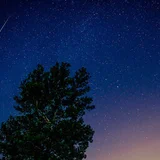
This week is a great opportunity to see the Perseid meteor shower. On the night before Thursday, up to 100 meteors per hour can be seen. On the same evening, Estonia will also experience a partial solar eclipse.
August nights offer many interesting phenomena. Planets, solar eclipses, and meteors are all visible this week. NASA says that under ideal conditions, 50–100 meteors per hour can be seen. In Estonia, the conditions are slightly different.
The meteors come from the constellation Perseus. In Estonia, the night is dark but not completely. Therefore, people mainly see bright meteors and bolides.
Meteors are actually space debris. They occur when small particles collide with Earth's atmosphere. Perseid meteors originate from the Swift-Tuttle comet.
The Perseids are popular because their meteors are bright. Also, summer nights are warm and comfortable for observation. The Moon's light does not interfere with this year's observation.
The best time to watch meteors is between midnight and dawn. Astronomers recommend observing the clear sky away from cities. Light from cities makes the sky too bright.
The eye needs time to adjust to the darkness. It is recommended to stay without light for at least 30 minutes. Even brief light disrupts the eye's adjustment.
For observation, it’s good to lie on the ground and look at one area of the sky. Then you’ll see even small meteors.
In Estonia, August nights are long and dark. The constellation Perseus rises early, making observation easier. It’s advisable to wear warm clothes and use a blanket.
Meteors are created from tiny particles, but they generate immense energy when they collide with the atmosphere. Larger particles leave a glowing trail in the sky.
Scientists use meteor observations to learn more about comet disintegration. Debris trails in space are not uniform.
On August 12, Estonia will also experience a partial solar eclipse. In Tallinn, it begins at 8:02 PM, reaches maximum at 8:53 PM, and ends at 9:19 PM.