
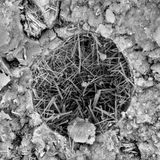
The ash hills of Ida-Virumaa are a common part of the Estonian landscape. Most people do not pay much attention to them. These hills remind us that oil shale is used for electricity production in Estonia.
Not all hills in Ida-Virumaa are ash hills. For example, there are also semicoke and ash residue hills. These are leftovers from oil shale processing. Some of these hills spontaneously ignited years ago and are still burning.
The largest ash hills are located near Narva. They are about 50 meters high and cover an area of nearly 20 square kilometers. There are over 300 million tons of oil shale ash there. This makes them some of the largest ash hills in the world.
The plateaus can only be accessed with special permits and safety training. There is not much to see there: the plateaus are flat and white as laundry. Fortunately, no hazardous substances leak into the groundwater there.
The ash is liquefied with water and transported via pipelines to the plateaus. There, the ash settles out of the water and a flat surface forms. On the plateau, the ash undergoes transformation and becomes suitable raw material for cement.
Previously, fresh ash was used in construction. For example, the Tallinn TV Tower and the Sosnovy Bor Nuclear Power Plant were built with it. However, the use of oil shale for electricity production will end in the future, so fresh ash will no longer be available.
Stored ash is chemically passive. To activate it, the ash needs to be ground and heated. This makes the ash chemically active again and suitable for cement production.
Cement production is environmentally burdensome. The use of oil shale ash reduces carbon dioxide emissions and production costs. This makes the production of construction materials cheaper and more environmentally friendly.
Richard Pihel talked about this in a lecture at the University of Tartu.