
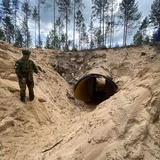
Setomaa metsadesse
on viimastel kuudel ehitatud
piiri äärde
hulga rajatisi. Need rajatised on osa
Balti kaitsevöönd
ist.
Palju tööd on veel teha
, aga osa rajatisi on juba valmis.
Setomaa metsadesse
Tõlge fraasile: Setomaa metsadesse
EN
Into the forests of Setomaa
piiri äärde
Tõlge fraasile: piiri äärde
EN
near the border
Balti kaitsevöönd
Tõlge fraasile: Balti kaitsevöönd
EN
Baltic defense zone
Palju tööd on veel teha
Tõlge fraasile: Palju tööd on veel teha
EN
Much work remains to be done
Punkri juurde on tehtud
jooksurada
. Selle ehitamiseks on kasutatud
geotekstiili
ja
metallist armatuurvõrku
. Need on pandud külgedesse ja lae peale droonide kaitseks.
jooksurada
Tõlge fraasile: jooksurada
EN
running track
geotekstiili
Tõlge fraasile: geotekstiili
EN
geotextile
metallist armatuurvõrku
Tõlge fraasile: metallist armatuurvõrku
EN
metal reinforcement mesh
Kaitseväe peastaabi pioneerinspektor Ainar Afanasjev ütleb, et hetkel on rajatud kaks
tugipunkti
. Üks Kirde- ja teine Kogu-Eestisse.
tugipunkti
Tõlge fraasile: tugipunkti
EN
support points
Kokku on paigaldatud 28 punkrit. Lisaks on rajatud Kogu-Eestis 10 kilomeetrit
tankitõrjekraavi
. On tarnitud üle 20 000
draakonihamba
. Need on paigaldatud eelladustamisaladele ehk positsioonide lähedale.
tankitõrjekraavi
Tõlge fraasile: tankitõrjekraavi
EN
anti-tank ditch
draakonihamba
Tõlge fraasile: draakonihamba
EN
dragon's teeth
Riigikogu liige Peeter Tali kahtleb, kas praegused
tankitõrjekraavi
d on piisavalt tõhusad. Tema arvates peaksid kraavid olema laiemad, püstiste servadega ja sügavamad. Tali ütleb, et Eestil on vaja ka
jalaväemiine
.
tankitõrjekraavi
Tõlge fraasile: tankitõrjekraavi
EN
anti-tank ditch
jalaväemiine
Tõlge fraasile: jalaväemiine
EN
infantry mines
Kolonelleitnant Afanasjev ütleb, et seni tehtud
kraavid aitavad tanke aeglustada
. Tema sõnul on kraavid tehtud nii nagu nad peaksid olema. Ükski kraav üksi ei pea tanki kinni. Efektiivsemad kraavid nõuavad
rohkem ressurssi
, mida Eestil pole.
kraavid aitavad tanke aeglustada
Tõlge fraasile: kraavid aitavad tanke aeglustada
EN
ditches help slow down tanks
rohkem ressurssi
Tõlge fraasile: rohkem ressurssi
EN
more resources
In recent months, numerous structures have been built near the border in the forests of Setomaa. These structures are part of the Baltic defense zone. Much work remains to be done, but some structures are already complete.
A running track has been added to the bunker. Geotextile and metal reinforcement mesh have been used for its construction. These have been placed on the sides and roof for protection against drones.
Ainar Afanasjev, the engineering inspector of the Defense Forces Headquarters, says that currently two strongpoints have been established. One in Northeast and another in Southeast Estonia.
A total of 28 strongpoints have been installed. Additionally, 10 kilometers of anti-tank ditches have been constructed in Southeast Estonia. Over 20,000 dragon's teeth have been delivered. These have been installed near pre-prepared areas or positions.
Member of Parliament Peeter Tali doubts whether the current anti-tank ditches are effective enough. In his opinion, the ditches should be wider, with vertical edges and deeper. Tali says that Estonia also needs infantry mines.
Colonel Lieutenant Afanasjev says that the ditches built so far help slow down tanks. According to him, the ditches are made as they should be. No single ditch can stop a tank. More effective ditches require more resources, which Estonia does not have.