
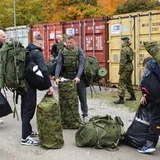
1. jaanuarist hakkab kehtima uus seadus. Kutsealused peavad oskama eesti keelt vähemalt B1-tasemel.
Valitsus tegi uue määruse. See aitab kontrollida kutsealuste keeleoskust ja korraldada keeleõpet.
Seaduse eesmärk on tagada, et ajateenijad saaksid turvaliselt ja edukalt eesti keeles õppida.
Kutsealused ei pea keeleoskust eraldi tõestama. Esmalt kontrollitakse andmeid riiklikest registritest.
Kui andmetest keeleoskust ei leita,
suunatakse inimene eksamile
. Eksami korraldab haridus- ja noorteamet.
suunatakse inimene eksamile
Tõlge fraasile: suunatakse inimene eksamile
EN
the person is directed to an exam
Enne keeleõppesse määramist tehakse eraldi test. See aitab määrata õppejõude ja õppemahusid.
Õppimine võib toimuda ka veebis. See on vajalik neile, kes ei saa kohapeal käia.
Riik maksab kutsealuste keeleõppe. Õppemahud sõltuvad tasemest ja võivad olla 100 kuni 250 tundi.
Kursustel osalemise eest makstakse hüvitist. See aitab katta sõidu- ja toidukulusid.
Pärast keeleõpet tehakse eksam. See näitab, kas eesmärk on saavutatud.
Kui kutsealune ei saa keeleõpet läbida, saab ta veel õppida. Kui ei õnnestu, peab ta järgmisel aastal uuesti proovima.
Kogu keeleõppe eelarve on 400 000 eurot aastas. See katab eksamid, kursused ja hüvitised.
A new law will come into force on January 1st. Conscripts must know Estonian at least at the B1 level.
The government has introduced a new regulation. It will help verify the language proficiency of conscripts and organize language training.
The purpose of the law is to ensure that conscripts can safely and successfully learn in Estonian.
Conscripts do not need to prove their language proficiency separately. First, data from national registries will be checked.
If language proficiency is not found in the data, the person will be directed to an exam. The exam is organized by the Education and Youth Board.
Before assigning language training, a separate test will be conducted. It will help determine instructors and the volume of training.
Training can also take place online. This is necessary for those who cannot attend in person.
The state will pay for the language training of conscripts. The volume of training depends on the level and can range from 100 to 250 hours.
Participants in the courses will receive compensation. It will help cover travel and food expenses.
After the language training, an exam will be conducted. It will show whether the goal has been achieved.
If a conscript fails the language training, they can continue learning. If they are unsuccessful, they must try again the following year.
The total budget for language training is 400,000 euros per year. It covers exams, courses, and compensations.